
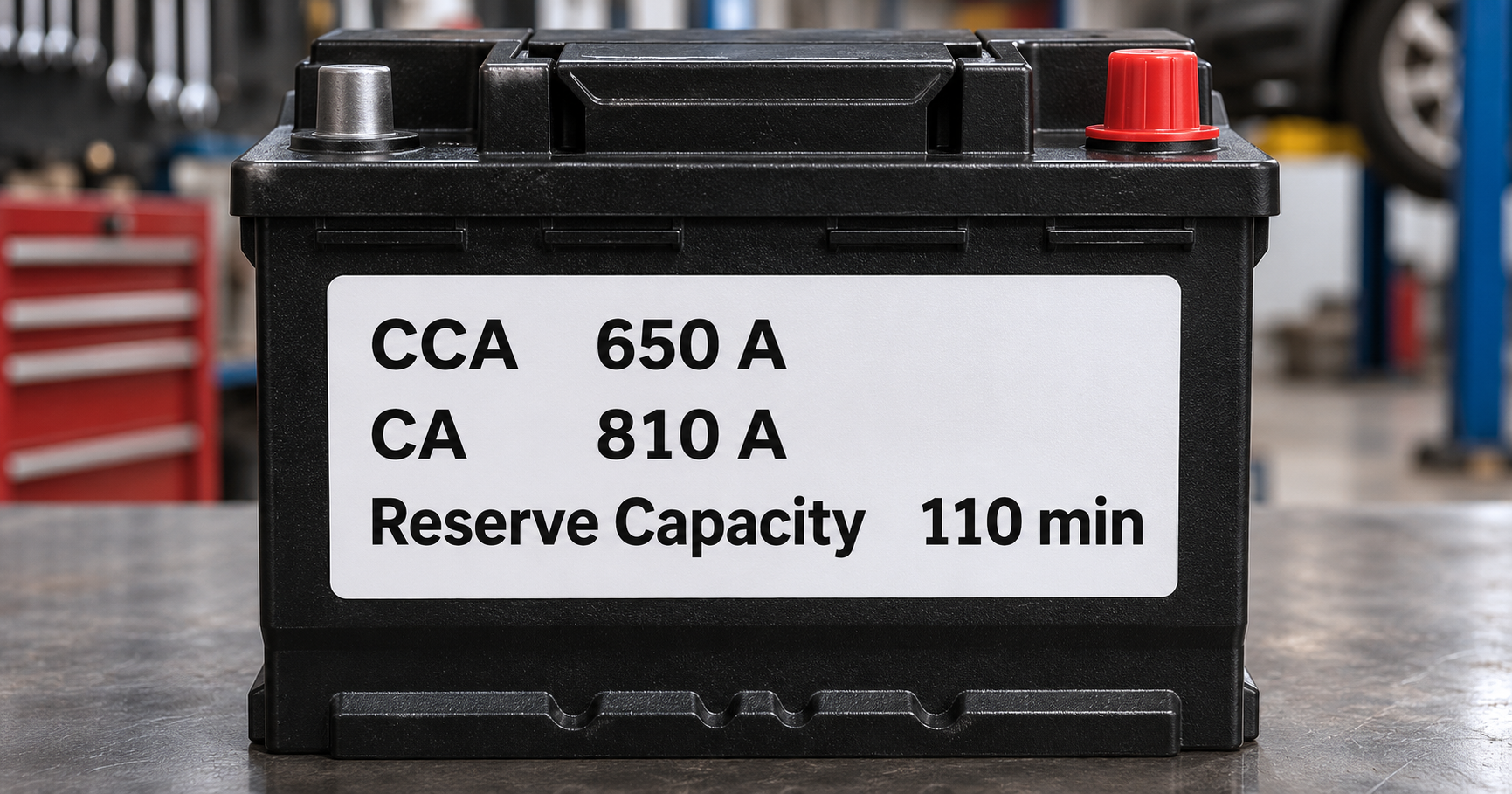
CCA, CA, and Reserve Capacity: How to Read Battery Ratings
November 25, 2026 4:29 pm Leave your thoughtsThe label on a battery is packed with numbers, and most drivers only glance at the brand and the price. For Houston vehicle owners, auto technicians, and fleet managers, those numbers tell you whether a battery will start your engine reliably, power your accessories, and stand up to Southeast Texas heat. Knowing how to read CCA, CA, and reserve capacity helps you choose the right battery the first time.
Quick Answer
Cold cranking amps (CCA) measure how much current a 12-volt battery can deliver for 30 seconds at 0°F while staying above 7.2 volts. Cranking amps (CA), sometimes called marine cranking amps, measure the same thing at 32°F, so the number is higher. Reserve capacity (RC) is how many minutes a fully charged battery can supply 25 amps at 80°F before dropping to 10.5 volts.
Battery Rating Basics Houston Drivers Should Know
Battery rating basics come down to a few numbers that describe starting power and staying power.
- CCA: Starting power in cold conditions, the most common rating on automotive batteries.
- CA or MCA: Starting power at 32°F, often listed on marine and some automotive batteries.
- Reserve capacity: Staying power, or how long the battery can run essential electrical loads if the charging system fails.
- Amp-hours (Ah): Total energy storage over a longer discharge, common on deep-cycle and commercial batteries.
- Group size: The physical dimensions and terminal layout, which must fit your vehicle or equipment.
Why Battery Ratings Matter in Houston
Battery ratings matter in Houston because heat, not cold, is usually the biggest threat to battery life along the Gulf Coast. Long, hot summers speed up internal corrosion and fluid loss, so a battery’s overall quality and reserve capacity can matter as much as its cold-weather starting power.
Stop-and-go traffic on I-610, I-45, and the Katy Freeway, along with heavy use of air conditioning and electronics, also places steady demand on the electrical system. Fleet vehicles and commercial equipment that idle often or run accessories need batteries matched to those loads.
At Texford Battery Co, we have served Houston since 1931 and carry access to more than 3,000 battery products. Our knowledgeable team helps customers match the right battery to their vehicle, equipment, or power system.
Understanding Cold Cranking Amps
Cold cranking amps tell you how well a battery can start an engine in cold weather. Engines are harder to turn over when oil thickens, and battery chemistry slows down at low temperatures.
Houston rarely sees long stretches of freezing weather, but cold snaps do happen. Meeting or exceeding the manufacturer’s recommended CCA is a good baseline. Choosing far more CCA than needed does not usually add value in a warm climate.
CCA vs. CA: What Is the Difference?
The difference between CCA and CA is the temperature at which each is measured. CA is tested at 32°F, while CCA is tested at 0°F. Because batteries perform better in warmer conditions, the CA number is always higher than the CCA number for the same battery.
When comparing batteries, make sure you compare CCA to CCA or CA to CA. Comparing one battery’s CA to another’s CCA can make the first battery look stronger than it really is.
Understanding Reserve Capacity
Reserve capacity shows how long a battery can keep essential systems running if the alternator stops charging. A higher RC number means more time to reach a safe location or keep critical electronics powered.
Reserve capacity is especially useful for vehicles with heavy electrical loads, work trucks with lighting or equipment, and drivers who want extra margin during long commutes or severe weather.
Signs You May Need a Different Battery
The clearest sign you may need a different battery is slow cranking, especially after the vehicle sits. Other signs include:
- Dim lights or electrical issues at idle.
- A battery that repeatedly needs a jump start.
- Swelling or bulging of the battery case.
- Corrosion on the terminals.
- A battery that is several years old in Houston heat.
- Added accessories that increase electrical demand.
Choosing the Right Ratings for Your Needs
Choosing the right ratings starts with the manufacturer’s recommendation for group size and minimum CCA. From there, consider your driving habits and electrical demands.
- Daily drivers: Match or slightly exceed recommended CCA, and look for solid reserve capacity.
- Fleet and work vehicles: Prioritize reserve capacity and durability for frequent stops and accessory loads.
- Marine and recreational: Review CA or MCA and amp-hour ratings based on use.
- Equipment and backup power: Amp-hours and cycle life often matter more than cranking amps.
Common Mistakes When Reading Battery Labels
- Mistake: Comparing CA on one battery to CCA on another. Consequence: Choosing a weaker battery. Better approach: Compare the same rating.
- Mistake: Focusing only on CCA in a hot climate. Consequence: Overlooking durability and reserve capacity. Better approach: Consider the full set of ratings.
- Mistake: Ignoring group size. Consequence: A battery that does not fit or connect properly. Better approach: Confirm size and terminal layout first.
A Common Local Scenario
A common local scenario involves a Houston fleet manager replacing batteries in service trucks that run lights and tools throughout the day. This is a typical example, not a case study. By looking beyond CCA and prioritizing reserve capacity and durability, the manager chooses batteries better suited to long, hot workdays.
How We Help You Choose the Right Battery
We help customers choose the right battery by explaining ratings, checking fit, and recommending options for automotive, industrial, and personal needs. Our store keeps a regular inventory of hard-to-find and foreign batteries and accessories.
We also offer battery testing, charging, and installation services, along with replacement and repair support for uninterruptible power systems.
Battery Ratings at a Glance
| Rating | What It Measures | Test Conditions |
|---|---|---|
| CCA | Starting power in cold weather | 30 seconds at 0°F, staying above 7.2 volts |
| CA / MCA | Starting power in moderate conditions | 30 seconds at 32°F |
| Reserve capacity | Minutes of power without charging | 25 amps at 80°F until 10.5 volts |
| Amp-hours | Total stored energy | Discharge over a set period |
Serving Houston and Southeast Texas
We serve Houston, Harris County, Fort Bend County, Montgomery County, Galveston County, Brazoria County, and nearby communities including Pasadena, Baytown, Humble, and Spring.
The Cost of Choosing the Wrong Battery
The cost of choosing the wrong battery can include unexpected breakdowns, shortened battery life, and downtime for vehicles and equipment. Understanding the ratings helps you avoid paying twice.
Frequently Asked Questions
What does CCA mean on a car battery?
CCA stands for cold cranking amps, the current a 12-volt battery can deliver for 30 seconds at 0°F while staying above 7.2 volts.
Is CCA or CA more important?
CCA is the more common standard for automotive batteries and the better rating for comparing cold-weather starting power. CA is measured at a warmer temperature, so it will read higher.
Do Houston drivers need high CCA batteries?
Houston drivers usually do not need CCA far above the manufacturer’s recommendation, because heat is a bigger factor than cold. Durability and reserve capacity often matter more.
What is reserve capacity on a battery?
Reserve capacity is how many minutes a fully charged battery can supply 25 amps at 80°F before dropping to 10.5 volts.
Can I install a battery with higher CCA than recommended?
Yes, a higher CCA battery is generally fine if it is the correct group size and type for your vehicle.
Does heat shorten battery life in Southeast Texas?
Yes, high heat can speed up internal wear and fluid loss, which is why battery testing and quality matter in Southeast Texas.
Battery labels make more sense once you know what each number means. With more than nine decades in Houston, we are here to help you choose with confidence.
Get the Right Battery for Houston Conditions
Our team will help you compare ratings and find the best fit for your vehicle or equipment.
Categorised in: Batteries
This post was written by admin