
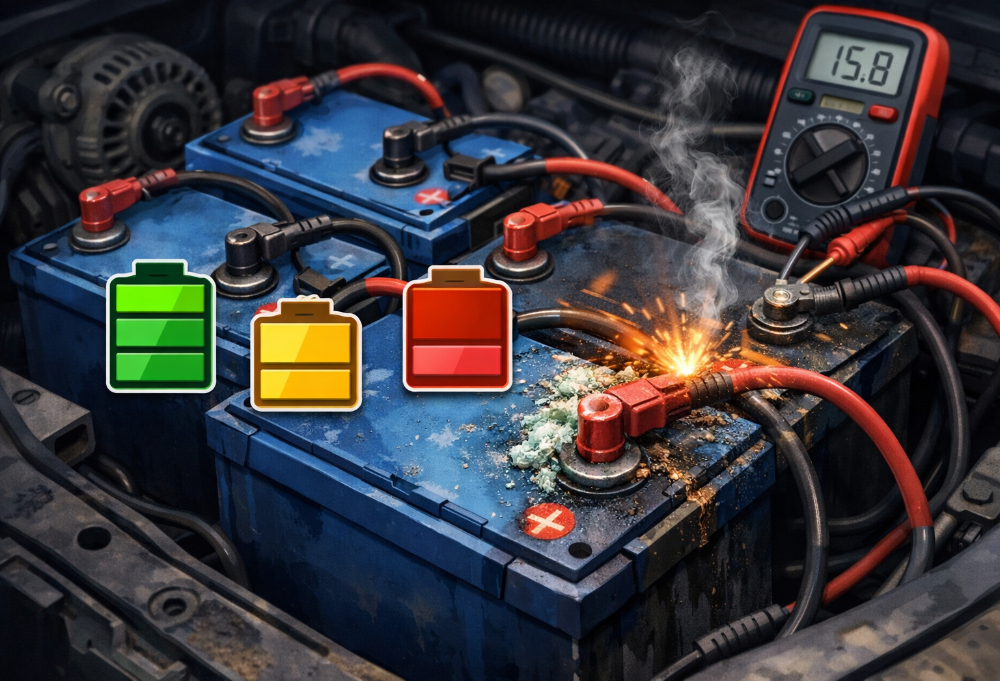
Why Uneven Charging Can Damage Multi-Battery Systems
March 22, 2026 3:27 pm Leave your thoughtsWhen you rely on multiple batteries to power your devices or systems, understanding the dangers of uneven charging becomes critically important. Many people don’t realize that batteries in series or parallel configurations require balanced charging to maintain longevity and performance. Uneven battery charging represents one of the most common yet overlooked threats to multi-battery systems, and addressing this issue can save you significant money on replacements and repairs.
Multi-Battery System Basics
Before diving into the problems caused by uneven battery charging, it’s essential to understand how multi-battery systems work. When batteries are connected in series, they increase the overall voltage while maintaining the same capacity. For example, four 1.5-volt batteries connected in series produce 6 volts total. When batteries are arranged in parallel, they increase capacity while maintaining the same voltage output. A properly functioning multi-battery system depends on all batteries contributing equally to power delivery and charging.
The challenge emerges because individual batteries within a pack rarely behave identically. Manufacturing variations, age differences, temperature fluctuations, and internal resistance variations mean that each battery has unique characteristics. When you charge a multi-battery system, these differences become amplified, leading to uneven battery charging patterns. Some batteries accept charge faster than others, while some resist charging more than their neighbors. This creates an imbalance that grows worse with each charging cycle.
The Physics Behind Uneven Charge Distribution
Uneven battery charging occurs due to fundamental physics principles governing electrical systems. When batteries with different internal resistances are connected in series, the battery with the highest resistance limits the overall charging current. However, individual batteries still try to reach their full charge capacity, which creates voltage imbalances across the pack.
In parallel configurations, uneven battery charging happens differently but equally problematically. The battery with the lowest internal resistance accepts charge first and most readily. This causes it to reach full capacity before other batteries finish charging. Once one battery reaches its maximum voltage, it can damage the charging circuit and create circulating currents between batteries. These parasitic currents flow from fully charged batteries back to partially charged ones, generating heat and wasting energy.
Temperature plays a crucial role in this dynamic. Batteries that charge faster generate more heat, which increases their internal resistance further. This creates a feedback loop where hot batteries charge slower, allowing cooler batteries to charge faster and generate more heat themselves. This thermal runaway effect demonstrates why temperature management is vital when dealing with battery charging problems in multi-battery systems.
Common Damage Patterns from Uneven Battery Charging
Uneven battery charging causes specific, measurable damage to battery systems. The most immediate effect is accelerated degradation of the overcharged batteries. When some batteries in a pack receive more charge than others, those overcharged units experience higher voltage stress. The positive electrode material in lithium-ion batteries, for example, becomes unstable at higher voltages, leading to increased oxidation and structural damage.
Undercharged batteries face different but equally serious problems. These batteries fail to reach their intended capacity, reducing overall system performance. More critically, undercharged batteries in series configurations can reverse-charge during discharge cycles. When this occurs, the battery acts as a resistor rather than a power source, generating dangerous heat and potentially failing explosively in lithium-based systems.
Battery cycling degradation accelerates significantly in unbalanced packs. Each charge cycle causes irreversible chemical changes in battery materials. Overcharged batteries suffer through more aggressive chemical reactions, reducing their lifespan dramatically. A battery pack with significant charge imbalance might lose 30-40 percent of its useful life compared to a perfectly balanced system. This represents substantial financial loss over the battery pack’s lifetime.
Preventing and Managing Uneven Battery Charging
Addressing uneven battery charging requires both preventive measures and active management strategies. The most effective solution involves using battery management systems (BMS) that monitor individual cell voltage and temperature in real-time. These sophisticated electronic systems prevent overcharging by automatically balancing charge distribution across the battery pack.
Passive balancing systems use resistor networks to dissipate energy from overcharged batteries, bringing all cells to the same voltage level. While simple and inexpensive, passive systems waste considerable energy as heat. Active balancing systems transfer energy from overcharged cells to undercharged ones, maintaining balance while preserving efficiency. Active systems cost more upfront but provide superior long-term value.
Temperature management represents another critical prevention strategy. Maintaining consistent temperatures across all batteries in a pack prevents the thermal effects that cause uneven battery charging. This might involve thermal insulation, active cooling systems, or strategic placement within the device. Many modern battery packs incorporate temperature sensors and thermal management circuits specifically to combat this problem.
Regular monitoring and maintenance help catch charging problems early. Users should watch for voltage disparities between individual batteries and replace any consistently underperforming units. In professional applications, capacity testing can identify batteries that deviate from expected performance, allowing replacement before catastrophic failure occurs.
Real-World Consequences and Case Studies
Understanding the real-world impact of uneven battery charging helps illustrate why this issue demands attention. Electric vehicle manufacturers have invested billions in battery management systems because uneven charging directly impacts vehicle range and safety. A Tesla or similar EV uses sophisticated balancing algorithms to ensure each cell in the battery pack receives appropriate charge levels. Without this technology, vehicles would suffer range loss and potential battery fires.
Uninterruptible power supply (UPS) systems in data centers demonstrate another critical application. These systems often use large battery banks to provide backup power during outages. Uneven battery charging in these systems can cause sudden failures when the UPS activates, leaving critical infrastructure offline. Companies have lost millions due to UPS failures caused by neglected battery balancing systems.
Consumer electronics face less dramatic but still significant consequences. Laptop batteries that aren’t properly balanced degrade faster and sometimes fail suddenly. Phone batteries in devices with multiple cells can swell due to uneven charging, damaging internal components and creating safety hazards. These battery charging problems affect billions of devices worldwide.
Advanced Solutions and Future Technologies
The battery industry continues developing better solutions for managing uneven battery charging. Artificial intelligence and machine learning algorithms now predict individual cell behavior and adjust charging profiles dynamically. Some systems can learn each battery’s unique characteristics and optimize charging in real-time, achieving superior balance compared to traditional methods.
Solid-state battery technology promises to reduce internal resistance variations between cells, naturally decreasing uneven battery charging problems. These next-generation batteries distribute charge more uniformly, requiring less sophisticated management systems. As solid-state technology matures, battery charging problems may become far less critical.
Wireless power transfer systems offer another promising approach. By eliminating direct electrical connections, wireless systems reduce the pathways for charge imbalance. Research teams worldwide are exploring how wireless transfer can simplify battery charging problems in multi-battery applications.
Conclusion
Uneven battery charging represents a significant threat to any system using multiple batteries. The physics of charge distribution, combined with natural manufacturing variations, creates unavoidable imbalances that accelerate degradation and reduce system lifespan. Implementing proper battery management systems, maintaining consistent temperatures, and monitoring individual cell performance can effectively mitigate these risks. Whether protecting critical infrastructure or extending consumer device lifespans, understanding and managing uneven battery charging is essential for maximizing battery system reliability and value.
Need a Battery Store in Houston, TX?
At Texford Battery Co, we pride ourselves on being much more than just another battery specialist. We credit our seven decades of business growth and success to the unmatched service and expertise our team provides. Texford Battery Co is not simply a supplier – we helped pave the way for many innovations in the battery distribution industry that continue to keep prices competitive for our customers. Among them, we were a leader in the creation of the Battery Marketing Group in the 1970s. As a founding member of this national network of battery distributors and manufacturers, we are able to offer up to 10,000 of the industry’s top products to our customers at the lowest cost. Call us today!Categorised in: Battery Chargers
This post was written by admin