
How Sulfation Affects Industrial Batteries and What Can Be Done
March 22, 2026 3:27 pm Leave your thoughtsIndustrial batteries power countless operations across manufacturing plants, data centers, renewable energy systems, and backup power installations. Yet despite their critical role, many facility managers remain unaware of a common degradation process that silently compromises battery performance: sulfation. Understanding industrial battery sulfation and recognizing its signs can mean the difference between a properly functioning power system and costly downtime.
Understanding Industrial Battery Sulfation
Industrial battery sulfation occurs when lead-acid batteries, the most common type used in industrial applications, develop a buildup of lead sulfate crystals on the battery plates. This chemical process happens naturally during the discharge cycle of lead-acid batteries. When a battery discharges, the lead dioxide positive plate and the lead negative plate react with sulfuric acid electrolyte to produce lead sulfate. Under normal operating conditions, the charging process reverses this reaction, converting lead sulfate back into lead and lead dioxide.
However, when batteries remain in a partially discharged state or are repeatedly undercharged, the lead sulfate crystals harden and become increasingly resistant to the normal charging process. These hardened crystals accumulate over time, forming a thick layer on the battery plates. This crystalline buildup is what battery professionals call sulfation, and it represents one of the most common causes of premature battery failure in industrial settings. The process can develop gradually over weeks or months, or it can accelerate rapidly if batteries are exposed to specific conditions like high temperatures, deep discharges, or prolonged storage without proper maintenance.
The chemistry behind sulfation makes it particularly problematic for industrial operations. As the lead sulfate crystals grow larger and more numerous, they reduce the active surface area available for chemical reactions within the battery. This means the battery loses its ability to accept and deliver electrical current efficiently. What starts as a minor performance degradation can eventually render a battery completely unusable if left unchecked.
Signs of Sulfated Industrial Batteries
Recognizing the signs of sulfated industrial batteries early allows operators to take corrective action before complete failure occurs. One of the most noticeable indicators is a significant decline in battery voltage under load. When sulfation develops, the battery struggles to maintain voltage during discharge cycles, and operators may notice that backup power systems activate earlier than expected or fail to provide the rated power capacity.
Another key warning sign involves prolonged charging times. Sulfated batteries require longer periods to achieve full charge compared to healthy batteries. If your maintenance team notices that a battery bank consistently takes significantly longer to charge than comparable batteries, sulfation may be the culprit. Additionally, sulfated batteries often show elevated temperatures during both charging and discharging cycles, as the accumulated lead sulfate crystals increase internal resistance.
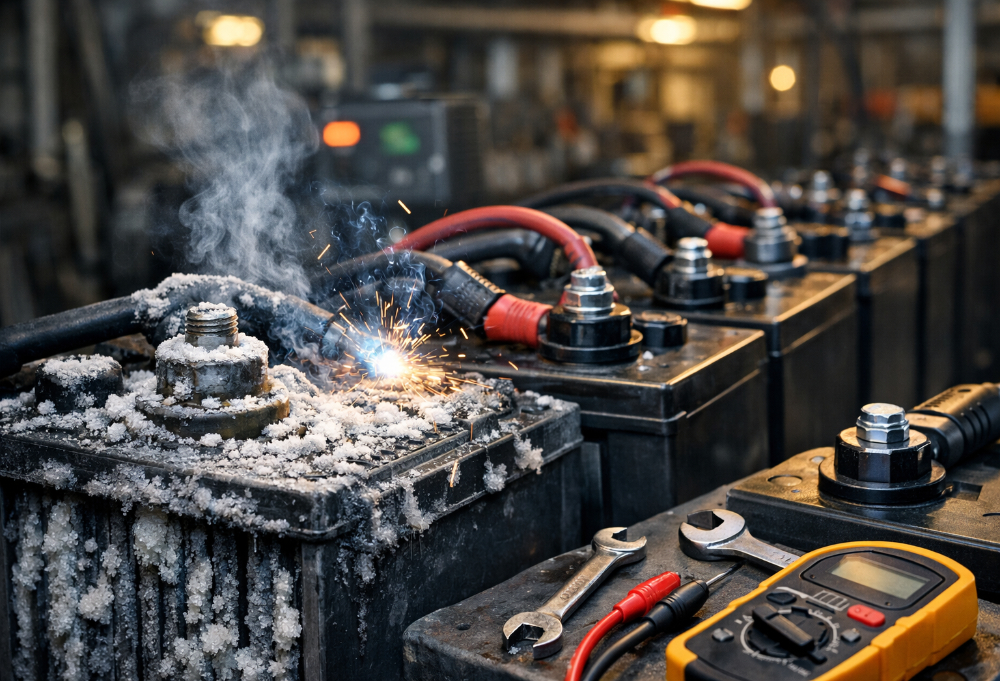
Physical inspection can also reveal sulfation problems. Experienced technicians look for a white or grayish crystalline buildup visible on battery terminals or through battery case windows if the design allows viewing. Some industrial battery monitoring systems can detect sulfation through voltage measurements and resistance testing, providing early warning before performance degrades noticeably.
Battery capacity tests represent another diagnostic tool. When batteries are tested under standard load conditions, sulfated batteries show reduced ampere-hour capacity compared to their rated specifications. A battery rated for 1000 ampere-hours that consistently delivers only 750 ampere-hours may be experiencing sulfation. These capacity reductions typically worsen over time if the underlying sulfation remains untreated.
Prevention Strategies for Industrial Batteries
Preventing sulfation proves far more effective and cost-efficient than attempting to reverse the damage once it has progressed significantly. The foundation of sulfation prevention rests on maintaining proper battery charging protocols. Industrial batteries should be charged with the correct voltage and current settings specific to their chemistry and construction. Many facilities benefit from investing in intelligent charging systems that monitor individual battery conditions and adjust charging parameters automatically.
Temperature management represents another crucial prevention strategy. Sulfation accelerates in hot environments, so maintaining battery storage and operating areas at moderate temperatures (ideally between 60 and 80 degrees Fahrenheit) helps slow the chemical processes that create sulfate crystals. Proper ventilation and climate control systems in battery rooms protect against temperature extremes that trigger rapid sulfation.
Regular equalization charging is essential for lead-acid battery banks. This process involves periodically charging the battery to a slightly higher voltage than normal to ensure all cells maintain balanced charge levels. Equalization prevents some cells from remaining in a partial discharge state while others are fully charged, a condition that promotes sulfation in the undercharged cells. Most industrial operations should perform equalization charging monthly or according to manufacturer recommendations.
Maintaining proper water levels in flooded lead-acid batteries also prevents sulfation. When water levels drop, plate exposure increases, accelerating sulfation in exposed areas. Regular monitoring and timely water additions keep plates submerged and protect against this form of accelerated degradation.
Treatment and Recovery Options
For batteries already showing signs of sulfation, several intervention methods exist depending on the severity of the condition. Desulfation involves applying specialized charging protocols or using desulfation devices that generate specific electrical pulses to break up hardened lead sulfate crystals. Some industrial facilities employ desulfation equipment that can recover partially sulfated batteries before they reach complete failure.
Chemical additives designed specifically for lead-acid battery desulfation exist in the market. These compounds work by helping to dissolve lead sulfate crystals back into solution where they can participate in normal electrochemical reactions. However, chemical treatments work best when sulfation remains in early stages and are less effective against extensive crystalline buildup.
For severely sulfated batteries, replacement becomes the most practical option. Attempting to recover heavily sulfated batteries often requires more time and money than simply installing new units. Industrial managers must weigh the cost of potential recovery against the expense of new batteries plus any risk of system failures during the recovery process.
Best Practices for Industrial Battery Management
Implementing a comprehensive battery management program prevents most sulfation problems before they develop. This program should include regular voltage and resistance testing, capacity testing on scheduled intervals, temperature monitoring, and maintaining detailed records of battery performance over time. Trends in these measurements reveal problems early when intervention proves most effective.
Staff training ensures that battery handling and charging practices support longevity. Operators need to understand the relationship between charging protocols and sulfation risk. Many battery failures result from well-intentioned but incorrect maintenance practices that actually accelerate sulfation.
Investing in proper infrastructure for battery storage and operation pays dividends through extended battery life. This includes climate-controlled rooms, appropriate racks and terminals, and backup charging systems that maintain batteries even during extended power outages at the facility.
Conclusion
Sulfation represents a preventable threat to industrial battery performance and reliability. By understanding how this process develops, recognizing early warning signs, and implementing proper prevention and maintenance practices, facility managers can dramatically extend battery life and ensure consistent power availability. Treating industrial battery sulfation as part of a comprehensive battery management strategy, rather than waiting for failure, protects both equipment investments and critical operations that depend on reliable backup power systems.
Need a Battery Store in Houston, TX?
At Texford Battery Co, we pride ourselves on being much more than just another battery specialist. We credit our seven decades of business growth and success to the unmatched service and expertise our team provides. Texford Battery Co is not simply a supplier – we helped pave the way for many innovations in the battery distribution industry that continue to keep prices competitive for our customers. Among them, we were a leader in the creation of the Battery Marketing Group in the 1970s. As a founding member of this national network of battery distributors and manufacturers, we are able to offer up to 10,000 of the industry’s top products to our customers at the lowest cost. Call us today!Categorised in: Industrial Batteries
This post was written by admin